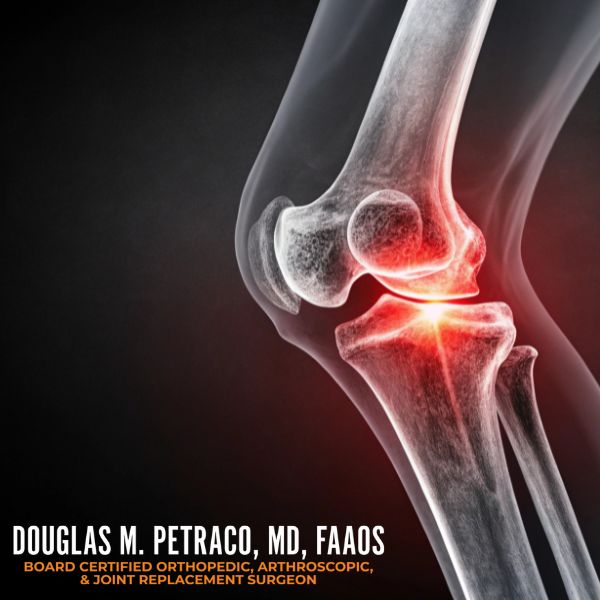
Total Knee Replacement in Long Island, NY — Dr. Douglas M. Petraco, MD
Dr. Douglas M. Petraco, a board-certified orthopedic surgeon and fellowship-trained joint replacement specialist, offers total knee replacement to patients across Long Island from his offices in East Setauket, Riverhead, and Port Jefferson. Many patients undergo surgery at Precision Care Surgery Center in East Setauket and return home the same day, typically within three hours of their procedure.
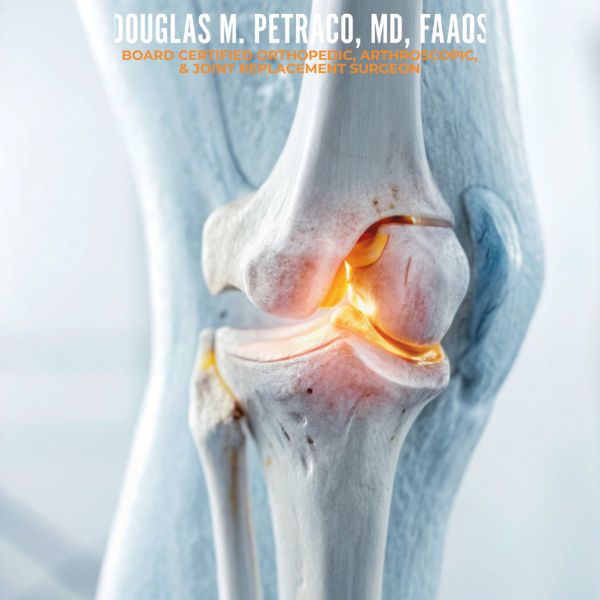
What Is Total Knee Replacement Surgery?
Dr. Petraco typically recommends total knee replacement for patients who have:
- Severe knee pain from osteoarthritis, rheumatoid arthritis, or post-traumatic arthritis
- Significant cartilage loss that causes bone-on-bone contact
- Knee deformity, such as bowing inward or outward
- Persistent pain that does not respond to physical therapy, injections, or anti-inflammatory medications
- Restricted knee mobility that limits daily activities or independence
Why Choose Dr. Petraco for Hip Replacement on Long Island?
He is a Fellow of the American Academy of Orthopedic Surgeons and board-certified by the American Board of Orthopedic Surgery. His leadership roles include:
- Director of the Orthopedic Surgery Department, St. Charles Hospital
- Orthopedic Service Line Director, Catholic Health Services
- Medical Director, Precision Care Surgery Center, East Setauket
At St. Charles Hospital, Dr. Petraco was instrumental in introducing MAKOplasty® robotic partial knee resurfacing, a precision technology that uses robotic assistance to plan and execute knee procedures with greater accuracy than conventional techniques.

Surgical Techniques: Minimally Invasive and Robotic-Assisted Options
Dr. Petraco employs both minimally invasive and robotic-assisted surgical approaches to total knee replacement, selecting the technique most appropriate for each patient’s anatomy and condition.
Minimally invasive knee replacement uses smaller incisions and modified instrumentation to limit disruption to the surrounding muscles and soft tissues. This approach is associated with:
- Reduced blood loss during surgery
- Less post-operative pain and swelling
- Faster mobilization and rehabilitation
- Shorter stay at the surgical facility
For eligible patients, MAKOplasty® robotic-assisted technology provides an additional layer of precision. A patient-specific surgical plan is developed in advance, and the robotic system helps guide implant placement within pre-defined boundaries, supporting more accurate alignment and potentially a more natural-feeling knee after recovery.
Interested in whether a partial or total replacement is right for your situation? See Dr. Petraco’s knee replacement overview for a comparison of available approaches.
Preoperative Evaluation and Surgical Planning
This evaluation also helps identify medical factors that need to be optimized before surgery, such as blood pressure, blood sugar control, and prior medications. The goal is to ensure that the procedure is performed at the right time, in the right setting, and with the safest plan for each individual patient.
Non-surgical options are discussed during this process. Knee replacement is recommended only when the level of pain and functional loss makes surgery the most appropriate next step.
Total Knee Replacement Recovery: What to Expect
Recovery timelines vary by patient, but Dr. Petraco’s approach prioritizes early movement and structured rehabilitation to support the best possible long-term outcomes. Patients who have surgery at Precision Care Surgery Center in East Setauket are typically discharged home within a few hours of their procedure.
A personalized rehabilitation program is developed for each patient after surgery, focusing on:
- Physical therapy to rebuild quadriceps strength and restore knee range of motion
- Gradual progression from walking aids to independent ambulation
- Activity guidelines to protect the new joint during the healing phase
- Scheduled follow-up visits to monitor recovery and implant performance
Most patients resume light daily activities within a few weeks and are cleared for more demanding activities within two to three months. Long-term outcomes following total knee replacement are generally excellent; the majority of patients report significant pain reduction and improved mobility.